









Teltonika TRM500 5G Industrial Modem with USB-C and DIN Rail Mount
The Teltonika TRM500 is a compact 5G industrial modem that delivers high-speed cellular connectivity for IoT and M2M deployments. With support for 5G Sub‑6 GHz SA and NSA networks, it achieves downlink speeds up to 3.4 Gbps and uplink up to 900 Mbps, while a USB‑C interface provides both data and power. Its rugged, anodized aluminum housing and flexible mounting options make it ideal for demanding industrial environments.
- 5G Performance
- Sub‑6 GHz SA 2.4 Gbps DL / 900 Mbps UL; NSA 3.4…
- 4G & 3G Fallback
- LTE Cat 19 up to 1.6 Gbps DL / 200 Mbps UL; 3G…
- USB‑C Connectivity
- Virtual network interface over USB Type‑C, powe…
- Industrial Power
- 4‑pin DC socket (9–30 VDC) with overvoltage, re…
Description
Highlights at a Glance
- 5G Performance: Sub‑6 GHz SA 2.4 Gbps DL / 900 Mbps UL; NSA 3.4 Gbps DL (4×4 MIMO) / 550 Mbps UL
- 4G & 3G Fallback: LTE Cat 19 up to 1.6 Gbps DL / 200 Mbps UL; 3G up to 42 Mbps DL
- USB‑C Connectivity: Virtual network interface over USB Type‑C, powered by the host (5 V @ 3 A)
- Industrial Power: 4‑pin DC socket (9–30 VDC) with overvoltage, reverse polarity, and surge protection
- Rugged Design: Anodized aluminum housing, IP30 rated, operating temperature –40 °C to 75 °C
- Flexible Mounting: Supports DIN rail, wall, and flat surface installation with additional kits
- Broad OS Support: Compatible with Windows, Linux, and Android via standard drivers and management tools
Performance & Connectivity
The TRM500 harnesses the full potential of 5G Sub‑6 GHz networks. In standalone (SA) mode it delivers up to 2.4 Gbps downlink and 900 Mbps uplink, while non‑standalone (NSA) operation pushes downlink to 3.4 Gbps using 4×4 MIMO and uplink to 550 Mbps. When 5G is unavailable, the modem seamlessly falls back to 4G LTE Cat 19 with 1.6 Gbps downlink and 200 Mbps uplink, or to 3G at 42 Mbps down and 5.76 Mbps up. Four SMA antenna connectors ensure robust signal reception and support advanced MIMO configurations.
Power & Industrial Design
Engineered for harsh environments, the TRM500 features an anodized aluminum housing that dissipates heat efficiently and withstands temperatures from –40 °C to 75 °C. Its IP30 ingress protection guards against dust and accidental contact. Power is supplied either through a 4‑pin industrial DC socket accepting 9–30 VDC with built‑in overvoltage, reverse polarity, and surge protection (>35 VDC for 10 µs max), or via the USB Type‑C port when the host provides 5 V @ 3 A. Typical power consumption is under 5 W at idle and under 12 W at maximum load.
Management & Compatibility
The modem integrates effortlessly into existing IT infrastructures. A virtual network interface over USB Type‑C carries both data and power, eliminating the need for separate cables. It is compatible with Windows 7/8/8.1/10/11, Linux kernels 2.6 through 6.3, and Android 4.x to 13. Management is streamlined through Windows Connection Manager and Modem Manager for Linux, while a comprehensive driver suite—MBIM, QMI_WWAN, Gobinet, USB Serial, NDIS, GNSS, and RIL—ensures plug‑and‑play operation across platforms.
Deployment & Mounting
Measuring just 83 × 25 × 85.4 mm and weighing 94.5 g, the TRM500 fits into space‑constrained enclosures. It supports DIN rail, wall, and flat surface mounting using optional kits, giving system integrators the flexibility to install the modem exactly where it is needed. Status LEDs for power, 5G, and network activity provide at‑a‑glance diagnostics, while the single Mini‑SIM (2FF) slot supports 1.8 V and 3 V cards for global network access.
Specifications
| Mobile Module | 5G Sub‑6 GHz SA: 2.4 Gbps DL / 900 Mbps UL; 5G NSA Sub‑6 GHz: 3.4 Gbps DL (4×4 MIMO) / 550 Mbps UL (2×2); 4G LTE Cat 19: 1.6 Gbps DL / 200 Mbps UL; 3G: 42 Mbps DL / 5.76 Mbps UL |
| SIM | 1 × Mini SIM (2FF), 1.8 V / 3 V |
| Antenna Connectors | 4 × SMA for Mobile |
| USB Interface | 1 × USB Type‑C (virtual network interface; host must provide 5 V @ 3 A) |
| Power Connector | 1 × 4‑pin industrial DC socket |
| Input Voltage | 4‑pin: 9–30 VDC; USB Type‑C: 5 VDC |
| Power Consumption | Idle: < 5 W, Max: < 12 W |
| Status LEDs | 1 × Power, 1 × 5G, 1 × Network |
| Casing Material | Anodized aluminum housing and panels |
| Dimensions (W × H × D) | 83 × 25 × 85.4 mm |
| Weight | 94.5 g |
| Mounting Options | DIN rail, wall mount, flat surface (all require additional kit) |
| Ingress Protection | IP30 |
| Operating Temperature | –40 °C to 75 °C |
| Operating Humidity | 10% to 90% non‑condensing |
| Management Software | Windows Connection Manager, Modem Manager (Linux) |
| Driver Support | MBIM (Windows 8/8.1/10/11, Linux 3.18~6.3), QMI_WWAN (Linux 3.4~6.3), Gobinet (Linux 2.6/3.x/4.1~4.14), USB Serial (Windows 7/8/8.1/10/11, Linux 2.6~6.3, Android 4.x~13), NDIS (Windows 7/8/8.1/10/11), GNSS (Android 4.x~13), RIL (Android 4.x~13) |
| Regulatory Approvals | EN 55032:2015+A1:2020, EN 55035:2017+A11:2020, EN 61000‑3‑3:2013+A1:2019+A2:2021, EN IEC 61000‑3‑2:2019+A1:2021, EN 301 489‑1 V2.2.3, EN 301 489‑52 V1.2.1, AS/NZS CISPR 32:2015+A |
AI Fact Sheet
Downloads
Frequently Asked Questions (FAQ)
What certifications does the product carry?
Related products
- Industrieller kompakter 4G/LTE Dual SIM Router, mit Ethernet & I/O€229.50excl. VAT
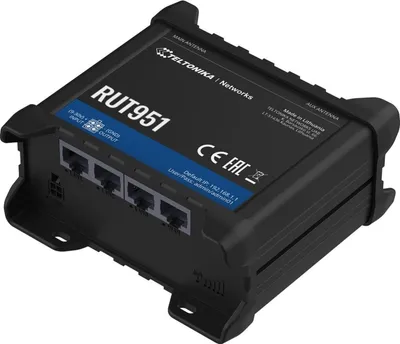
- Teltonika · Router · RUT976 · Redcap 5G Router · eSIM€332.56excl. VATRRP €357.42−7%

- TELTONIKA NETWORKS RUTX11 4G/LTE Router US Version€327.70excl. VAT

- Teltonika UK power supply, 24W€13.20excl. VAT
- Teltonika · Zubehör · Antenne · 5G MOBILE SLIM-SIDE SMA ANTENNA€3.98excl. VAT
