









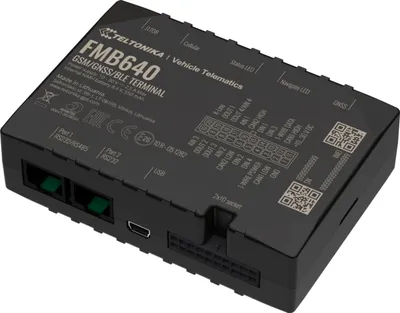
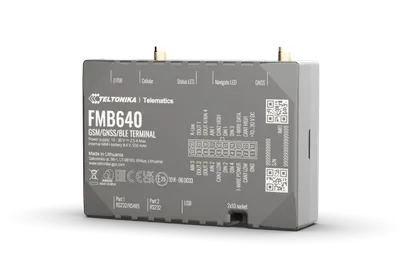
Teltonika Telematics Teltonika · Tracker GPS · FMB640 · Fahrzeug · GNSS/GSM/BLE 4.0
The Teltonika FMB640 is a 2G GNSS/GSM terminal for professional telematics applications, combining CAN data reading, multiple serial interfaces, and dual-SIM functionality in a single device. It is designed for heavy-duty transport, specialized machinery, and international logistics.
- Module
- Teltonika TM2500
- Technology
- GSM/GPRS/GNSS
- 2G Bands
- Quad-band 850 / 900 / 1800 / 1900 MHz
- GPRS Class
- Mobile Station Class B
Description
Key Benefits at a Glance
- Dual-SIM with two SIM card slots reduces roaming costs for international use
- CAN data reading via two J1939 and one J1708 interfaces for vehicle and machinery data
- Serial interfaces with two RS232, one RS485, and one 1-Wire port for third-party devices
- Internal backup battery with 550 mAh enables operation without an external power source
- Fuel monitoring via analog and digital sensors as well as CAN-based methods
- Accelerometer for ignition detection via digital input, accelerometer, or supply voltage
GNSS Performance & Positioning
The FMB640 supports satellite systems GPS, GLONASS, GALILEO, BEIDOU, SBAS, QZSS, and DGPS via 33/99 acquisition channels. Tracking sensitivity is -165 dBm with a positioning accuracy of under 3 m. Hot start takes less than one second, warm start under 25 seconds, and cold start under 35 seconds. Time synchronization is performed via GNSS, NITZ, or NTP. External high-gain antennas are used for GNSS and GSM.
Interfaces & Connectivity
The device features four digital inputs, four digital outputs, and four analog inputs. Two RS232 interfaces support modes such as Log Mode, NMEA, LLS, LCD, RFID HID/MF7, Garmin FMI, TCP ASCII/Binary, TCP ASCII/Binary (Buffered), Rec to LCD, Atol Tachograph, UL202-2 Fuel Sensor, TSM232 Satellite backup, and Carrier Freezer. One RS485 interface offers modes including Silent, Log Mode, NMEA, LLS, TCP ASCII/Binary, and TCP ASCII/Binary (Buffered). Additionally, two CAN J1939 interfaces, one J1708 interface, one K-line interface, and one 1-Wire port are available. Internal flash memory is 2 MB, expandable via micro-SD cards up to 32 GB. Connectivity is complemented by a USB 2.0 Mini-USB port and two status LEDs.
Fuel Monitoring
The FMB640 supports multiple fuel monitoring methods: analog LLS sensors, digital LLS sensors via RS232 and RS485, LV-CAN200, ALL-CAN300, CAN-CONTROL, and CAN FMS via J1939 and J1708. Additionally, ultrasonic level sensors can be connected. This range of supported methods enables fuel monitoring across various vehicle and machinery types.
Applications
The FMB640 is designed as a GNSS and GSM terminal for professional applications where a single device handles multiple tasks. It is ideal for international logistics, refrigerated transport, agriculture, construction and mining, as well as security and emergency services. The combination of CAN data reading via J1939 and J1708, multiple serial interfaces, and dual-SIM functionality makes it particularly suitable for heavy-duty vehicles and specialized machinery.
Power & Environmental Conditions
The input voltage range spans 10 to 30 V DC and includes overvoltage protection. An internal Ni-MH backup battery with 550 mAh and 8.4 V enables operation without an external power source. Three sleep modes—GPS Sleep, Online Deep Sleep, and Deep Sleep—reduce power consumption during idle periods. The operating temperature without the battery ranges from -40 °C to +85 °C, with the same range for storage. Humidity tolerance is 5 % to 95 % non-condensing, and the device meets IP41 protection standards. Battery storage temperature ranges from -20 °C to +45 °C.
Configuration & Firmware
Configuration and firmware updates are performed via FOTA Web, FOTA, or the Teltonika Configurator. SMS commands support configuration, event handling, DOUT control, and debugging. GPRS commands enable configuration, DOUT control, and debugging. These flexible remote access options simplify fleet management without requiring physical access to the device.
Specifications
| Module | Teltonika TM2500 |
| Technology | GSM/GPRS/GNSS |
| 2G Bands | Quad-band 850 / 900 / 1800 / 1900 MHz |
| GPRS Class | Mobile Station Class B |
| GPRS Multi-Slot | Class 12 (up to 240 kbit/s) |
| Data Services | SMS (Text/Data) |
| GNSS Systems | GPS, GLONASS, GALILEO, BEIDOU, SBAS, QZSS, DGPS |
| Receiver Channels | 33/99 acquisition |
| Tracking Sensitivity | -165 dBm |
| Positioning Accuracy | < 3 m |
| Hot Start | < 1 s |
| Warm Start | < 25 s |
| Cold Start | < 35 s |
| Time Synchronization | GNSS, NITZ, NTP |
| Digital Inputs | 4 |
| Digital Outputs | 4 |
| Analog Inputs | 4 |
| 1-Wire | 1 |
| RS232 | 2 |
| RS485 | 1 |
| CAN J1939 | 2 |
| J1708 | 1 |
| K-line | 1 |
| USB | 2.0 Mini-USB |
| SIM | 2x SIM card (Dual-SIM) |
| GNSS Antenna | External High Gain |
| GSM Antenna | External High Gain |
| LED Indicators | 2 status LEDs |
| Internal Flash Memory | 2 MB |
| External Memory | Micro-SD card up to 32 GB |
| Sensor | Accelerometer |
| Input Voltage | 10–30 V DC with overvoltage protection |
| Internal Backup Battery | 550 mAh Ni-MH, 8.4 V |
| Sleep Modes | GPS Sleep, Online Deep Sleep, Deep Sleep |
| Dimensions | 104.1 × 76.8 × 31.5 mm (L × W × H) |
| Weight | 197 g |
| Operating Temperature (without battery) | -40 °C to +85 °C |
| Storage Temperature (without battery) | -40 °C to +85 °C |
| Humidity | 5 % to 95 % non-condensing |
| Protection Class | IP41 |
| Battery Storage Temperature | -20 °C to +45 °C |
| Certifications | CE/RED, E-Mark, EAC, RoHS, REACH |
| Warranty | 24 months |
AI Fact Sheet
Downloads
Frequently Asked Questions (FAQ)
What certifications does the product carry?
What warranty does the product come with?
Related products
- TELTONIKA TELEMATICS FMB140 power cable€2.70excl. VAT

- Teltonika · Tracker GPS · FTC887€66.24excl. VAT

- TELTONIKA TELEMATICS FMS Cable€10.81excl. VAT

- TELTONIKA TELEMATICS FMM130 Advanced 4G LTE Cat M1 Tracker mit flexiblen Eingängen€46.38excl. VAT

- TELTONIKA TELEMATICS FMC234 Water-resistant 4G LTE Cat 1 tracker with high-capacity battery EMEA€81.20excl. VATRRP €83.36−3%
