










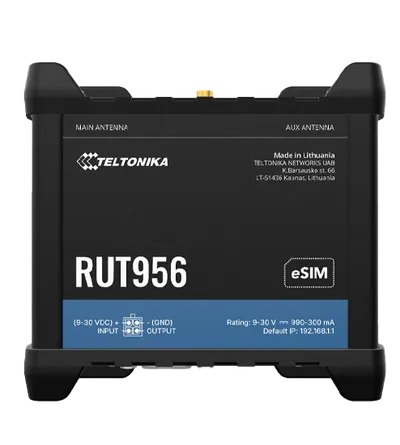
Teltonika RUT956 Dual-SIM LTE Router with Wi-Fi and GNSS
The Teltonika RUT956 is an industrial 4G LTE Cat 4 dual-SIM router with Wi-Fi and GNSS, designed for IoT and M2M applications that require reliable cellular connectivity and automatic network operator switching. It delivers speeds of up to 150 Mbit/s over LTE and combines four Ethernet ports, RS232/RS485, and an I/O block in a compact DIN-rail housing.
- LTE category
- 4G LTE Cat 4 up to 150 Mbit/s
- Cellular generations
- 4G (LTE), 3G up to 42 Mbit/s, 2G up to 236,8 kbit/s
- SIM slots
- dual SIM (mini SIM 2FF, 1.8 V/3 V), optional eSIM
- CPU
- Mediatek MIPS 24Kc 580 MHz
Description
Key Benefits
- Dual-SIM switching: automatic switching between two SIM cards on weak signal, data limit, roaming, or network denial.
- Multi-WAN failover: Wi-Fi WAN, cellular, VRRP, and wired connections can each serve as an automatic backup solution.
- Multi-constellation GNSS: GPS, GLONASS, BeiDou, Galileo, and QZSS with coordinate access via WebUI, SMS, TAVL, and RMS.
- Industrial environments: operation from -40 °C to 75 °C in an aluminium housing with DIN-rail or wall mounting.
- Remote management with RutOS: proprietary operating system with dynamic routing, VPN, firewall, and RMS compatibility.
Cellular Connectivity and Performance
The RUT956's cellular module supports 4G LTE Cat 4 with speeds of up to 150 Mbit/s, 3G up to 42 Mbit/s, and 2G up to 236,8 kbit/s. The two SIM slots accept 1.8 V/3 V mini SIM cards (2FF) in external slots plus optional eSIM, enabling network operator redundancy in critical deployments. SIM switching is triggered automatically on weak signal, data limit, SMS limit, roaming, network absence, network denial, data connection failure, or extended SIM inactivity.
Cellular signal monitoring displays metrics such as RSSI, SINR, RSRP, RSRQ, EC/IO, RSCP, sent and received bytes, the connected frequency, IMSI, and ICCID. Operator management includes blacklists and whitelists, frequency band locking, display of the active band, automatic APN setup, and multiple PDNs. The cellular antenna connectors are two female SMA sockets (MAIN and AUX), and the device supports SMS functions such as SMS status, SMS configuration, sending and reading via HTTP POST/GET, email to SMS, SMS to email, SMS to HTTP, scheduled SMS, autoreply, and SMPP, as well as USSD.
Networking, Routing, and Wi-Fi
Four 10/100 Mbit/s Ethernet ports comply with the IEEE 802.3 and IEEE 802.3u standards with Auto-MDI/MDIX; one is configurable as WAN, the remaining three as LAN. Load balancing distributes traffic across Wi-Fi WAN, cellular, VRRP, and wired connections, and each of these options can serve as automatic failover. Routing includes static and dynamic routes via BGP, OSPF v2, RIP v1/v2, and NHRP with static and dynamic IP assignment, DHCP relay, and relayd.
The network protocol stack includes TCP, UDP, IPv4, IPv6, ICMP, NTP, DNS, HTTP, HTTPS, FTP, SMTP, SSL v3, TLS, ARP, VRRP, PPP, PPPoE, UPnP, SSH, DHCP, Telnet, SMPP, SNMP, MQTT, and Wake On LAN. Quality of Service enables priority queues by source, destination, service, protocol, or port, as well as WMM and 802.11e. Wi-Fi complies with IEEE 802.11b/g/n in access point or station mode, supports up to 100 simultaneous connections, and offers WPA2-Enterprise (PEAP), WPA2-PSK, WEP, WPA-EAP, and WPA-PSK security with AES-CCMP and TKIP, hidden SSID mode, and MAC address access control. The two Wi-Fi antenna connectors are female RP-SMA sockets.
Security, Firewall, and VPN
The RUT956's firewall includes preconfigured rules that can be enabled via the WebUI, as well as unlimited configuration via the CLI, plus DMZ, NAT, and NAT-T. Attack protection includes DDoS protection with SYN flood defence, SSH and HTTP/HTTPS attack prevention, and port scan protection against SYN-FIN, SYN-RST, X-mas, NULL flags, and FIN scans. VPN support includes OpenVPN, IPsec, GRE, PPTP, L2TP, Stunnel, Tinc, and ZeroTier, and VLAN separation works by port and by tag. The integrated captive portal supports internal or external RADIUS servers with a customisable landing page.
GNSS and Positioning Services
The RUT956's GNSS receiver supports GPS, GLONASS, BeiDou, Galileo, and QZSS via a female SMA antenna connector. Coordinates can be retrieved via WebUI, SMS, TAVL, and RMS, and the device implements the NMEA 0183 and NTRIP protocols. Multiple geofencing zones can be configured to trigger events based on the device's location.
Serial Interfaces and I/O Block
The RUT956 features RS232 via a DB9 plug with full RTS and CTS signals at speeds from 300 to 115200 baud, as well as RS485 in full-duplex (4-wire) or half-duplex mode (2-wire) from 300 to 300000 baud. Serial functions include console, serial over IP, modem, MODBUS gateway, and NTRIP client. The I/O block provides a dry digital input (0 to 3 V), a galvanically isolated digital input (0 to 30 V), an analog input (0 to 24 V), and a non-isolated digital input on the 4-pin power connector, which detects 0 to 5 V as low level and 8 to 30 V as high level. Outputs include two open-collector outputs (30 V, 250 mA and 30 V, 300 mA on the 4-pin plug) as well as an SPST relay output (40 V, 4 A). The I/O juggler allows the definition of I/O conditions that trigger automatic events.
Design, Power, and Installation
The RUT956's compact industrial design measures 110 x 50 x 100 mm and weighs 287 g, with an aluminium housing and plastic covers. Mounting is possible on a DIN rail on both sides or on a flat surface, and the ingress protection rating is IP30. The input voltage range is 9 to 30 VDC with reverse polarity protection and overvoltage protection above 31 VDC for a maximum of 10 µs. Power consumption is less than 2 W at idle and less than 7 W at maximum load, and power is supplied via a 4-pin industrial DC plug. The device supports passive PoE over free wire pairs on the LAN1 port at 9 to 50 VDC, without compatibility with the IEEE 802.3af, 802.3at, or 802.3bt standards. The USB 2.0 port enables connection of storage media in FAT, FAT32, exFAT, NTFS (read-only), ext2, ext3, and ext4 formats, as well as additional modems, printers, or USB-to-serial converters via Samba.
Specifications
| LTE category | 4G LTE Cat 4 up to 150 Mbit/s |
| Cellular generations | 4G (LTE), 3G up to 42 Mbit/s, 2G up to 236,8 kbit/s |
| SIM slots | dual SIM (mini SIM 2FF, 1.8 V/3 V), optional eSIM |
| CPU | Mediatek MIPS 24Kc 580 MHz |
| RAM | 128 MB DDR2 |
| Storage | 16 MB SPI flash |
| Ethernet ports | 4x 10/100 Mbit/s (1 WAN + 3 LAN), IEEE 802.3, IEEE 802.3u, Auto-MDI/MDIX |
| Wi-Fi | IEEE 802.11b/g/n, up to 100 simultaneous connections, 2 x female RP-SMA |
| GNSS | GPS, GLONASS, BeiDou, Galileo, QZSS; NMEA 0183; NTRIP; 1 x female SMA |
| Serial interfaces | RS232 (DB9, 300 to 115200 baud), RS485 (full-duplex/half-duplex, 300 to 300000 baud) |
| I/O block | dry digital input 0 to 3 V, isolated digital input 0 to 30 V, analog input 0 to 24 V, non-isolated digital input 0 to 5 V / 8 to 30 V, open-collector outputs 30 V 250 mA and 30 V 300 mA, SPST relay 40 V 4 A |
| Cellular antenna connectors | 2 x female SMA (MAIN and AUX) |
| USB | USB 2.0 |
| Operating system | RutOS |
| VPN | OpenVPN, IPsec, GRE, PPTP, L2TP, Stunnel, Tinc, ZeroTier |
| Routing | static, BGP, OSPF v2, RIP v1/v2, NHRP |
| Input voltage | 9 to 30 VDC, reverse polarity protection, overvoltage >31 VDC max. 10 µs |
| Passive PoE | mode B, LAN1, 9 to 50 VDC (not compatible with IEEE 802.3af/at/bt) |
| Power consumption | < 2 W at idle, < 7 W max. |
| Operating temperature | -40 °C to 75 °C |
| Operating humidity | 10 % to 90 % non-condensing |
| Ingress protection | IP30 |
| Housing material | aluminium with plastic covers |
| Dimensions (W x H x D) | 110 x 50 x 100 mm |
| Weight | 287 g |
| Mounting | DIN rail (both sides) or flat surface |
| Warranty | 24 months |
| Certifications | CE/RED, UKCA, CB, EN 300 328 V2.2.2, EN 301 908-1 V13.1.1, EN 301 908-2 V13.1.1, EN 301 908-13 V13.1.1, EN 303 413 V1.1.1, EN 301 489-1 V2.2.3, EN 301 489-17 V3.2.4, Draft EN 301 489-19 V2.2.0, Final Draft EN 301 489-52 V1.2.0, EN 55032:2015+A1:2020, EN 55035:2017+A11:2020, EN 61000-3-3:2013+A1:2019 |
AI Fact Sheet
Downloads
Frequently Asked Questions (FAQ)
What certifications does the product carry?
Related products
- TRB236 - Industrial IoT LTE 450 IoT Gateway, LTE CAT.1 / 2G, Dual-SIM€178.88excl. VAT
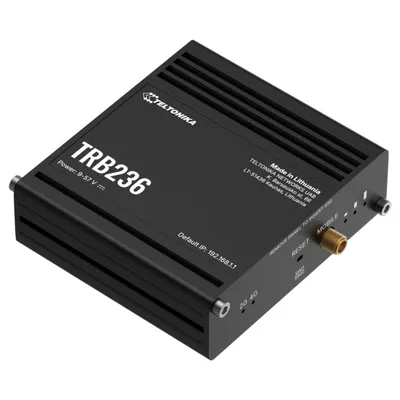
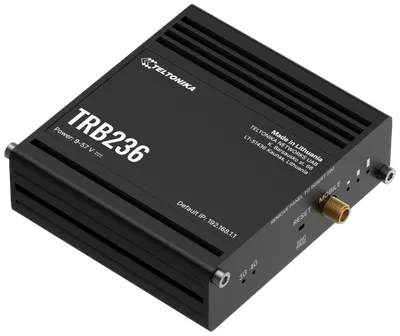
- TRB236 - Industrial IoT LTE 450 IoT Gateway, LTE CAT.1 / 2G, Dual-SIM TRB236 - I€186.34excl. VAT
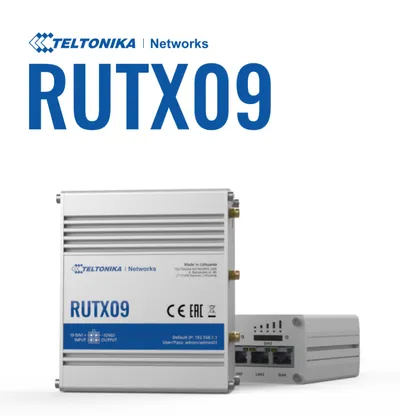
- TELTONIKA NETWORKS RUTX09 4G/LTE Router€254.59excl. VAT

- TELTONIKA NETWORKS RUT951 Dual SIM 4G/LTE/3G/2G Global WiFi Router€232.15excl. VAT

- Teltonika · Router · RUTX09 · Industrial LTE Modem Router Cat6 "ONLY LAN" 300Mbps Down/42Mbps UP€297.66excl. VATRRP €303.60−2%