










Teltonika TRB143 Industrial Gateway with LTE CAT4 and M-Bus
The industrial gateway Teltonika TRB143 combines mobile 4G LTE Cat 4 connectivity with speeds up to 150 Mbit/s and an integrated M-Bus interface for up to 250 slave devices. Designed for telemetry and metering applications, it enables secure data collection and transmission via cellular or Gigabit Ethernet.
- Cellular network
- 4G (LTE) Cat 4 up to 150 Mbit/s, 3G up to 42 Mbit/s, 2G up to 236.8 kbit/s
- Processor
- ARM Cortex-A7 1.3 GHz
- RAM
- 256 MB DDR3
- Flash memory
- 512 MB SPI Flash
Description
Key Features at a Glance
- 4G LTE Cat 4 connectivity with speeds up to 150 Mbit/s and 3G and 2G fallback
- Integrated M-Bus interface for controlling up to 250 slaves and powering up to 6 devices
- Gigabit Ethernet 10/100/1000 Mbit/s via an RJ45 port with Auto MDI/MDIX
- IP30-rated aluminium housing for operating temperatures from -40 °C to 75 °C, mountable on DIN rail or flat surface
- Remote management via RMS with TR-069, SNMP, SSH, MQTT, and JSON-RPC
- Multiple VPNs: OpenVPN, IPsec, WireGuard, ZeroTier, L2TP, SSTP, DMVPN, Tinc, Stunnel
- IoT integrations: Cloud of Things, ThingWorx, Cumulocity, Azure IoT Hub, MQTT, DNP3
Mobile Connectivity and M-Bus
The TRB143 features a 4G LTE Cat 4 cellular module with a maximum download speed of 150 Mbit/s, as well as backward compatibility with 3G (up to 42 Mbit/s) and 2G (up to 236.8 kbit/s). A Mini-SIM slot (2FF, 1.8 V/3 V) and a dedicated SMA antenna connector for LTE ensure wireless connectivity. The gateway supports LTE-FDD and LTE-TDD bands for Europe, the Middle East, Africa, Thailand, and Japan, along with corresponding 3G and 2G bands.
The integrated M-Bus interface is the standout feature of the TRB143 for telemetry and metering applications. It can manage up to 250 slave devices on the bus and power up to 6 of them directly, eliminating the need for an external power supply for low-consumption meters. The M-Bus wiring consists of four wires: power (red), I/O (green), ground (black), and I/O (white).
Performance and Hardware Architecture
The TRB143 is built on an ARM Cortex-A7 processor running at 1.3 GHz, supported by 256 MB of DDR3 RAM and 512 MB of SPI flash memory. This architecture runs RutOS, an OpenWrt Linux-based operating system that provides a comprehensive environment for routing, firewall, and event management. Power consumption remains low: 3 W at idle and 6 W under maximum load.
Power is supplied via an industrial 4-pin DC connector with a voltage range of 12 to 30 VDC. Passive PoE (Mode B, 12 to 30 VDC) is also available via the LAN1 port, though it is not compatible with IEEE 802.3af, 802.3at, or 802.3bt standards. The 4-pin connector also includes a digital input and a digital output: the input detects a low logic level between 0 and 6 V and a high level between 8 and 30 V, while the output, an open-collector type, delivers up to 30 V and 300 mA.
Routing, Firewall, and VPN
The gateway implements a comprehensive range of network protocols, including TCP, UDP, IPv4, IPv6, ICMP, NTP, DNS, HTTP, HTTPS, SFTP, FTP, SMTP, SSL/TLS, ARP, VRRP, PPP, PPPoE, UPnP, SSH, DHCP, Telnet, SMPP, SNMP, MQTT, and Wake On LAN. Static routing, port forwarding, traffic rules, and custom rules can be configured via the web interface or command line. Quality of Service (QoS) allows traffic prioritisation by source, destination, service, protocol, or port, with support for WMM and 802.11e.
The firewall includes preconfigured rules that can be enabled via the web interface, as well as unlimited configuration options via the CLI, including DMZ, NAT, and NAT-T. Protection against attacks includes DDoS (SYN-flood protection, prevention of SSH and HTTP/HTTPS attacks) and port scan prevention (SYN-FIN, SYN-RST, X-mas, NULL flags, FIN scan). Authentication is based on pre-shared keys, digital X.509 certificates, TACACS+, and Radius with IP and connection attempt blocking. The gateway supports a wide range of VPNs: OpenVPN, IPsec (IKEv1, IKEv2), GRE, GRE over IPsec, PPTP, L2TP, L2TP over IPsec, Stunnel, DMVPN, SSTP, ZeroTier, WireGuard, and Tinc. OpenVPN supports encryption algorithms from DES-CBC 64 to AES-256-GCM 256, while IPsec offers 14 encryption methods, including 3DES, DES, AES128, AES192, AES256, and their GCM variants.
Industrial Protocols and IoT Integration
The TRB143 functions as a Modbus TCP gateway, simultaneously acting as both master and slave. As a master, it supports functions 01, 02, 03, 04, 05, 06, 15, and 16 with data formats of 8-bit (INT, UINT), 16-bit (INT, UINT, MSB or LSB first), and 32-bit (Float, INT, UINT in ABCD, DCBA, CDAB, or BADC). As a slave, it responds to an ID in the range of 1 to 255 or to any ID, allows WAN access, manages custom registers, and enables remote access. The DNP3 protocol is also supported in TCP Master and Outstation modes.
The gateway integrates an MQTT broker and MQTT publisher, enabling command transmission and data reception from a Modbus master via MQTT. Data can be sent to servers via HTTP(S), MQTT, Azure MQTT, and Amazon Kinesis. Four IoT platforms are directly supported: Cloud of Things, ThingWorx, Cumulocity, and Azure IoT Hub. System and I/O events can trigger notifications via email, SMS, or the remote management system RMS, with an I/O juggler module allowing the definition of specific input/output conditions to trigger an event.
Remote Management and Monitoring
Remote management of the TRB143 is handled via the Teltonika Remote Management System (RMS), which enables centralised monitoring, configuration, and firmware updates. The gateway also supports TR-069 with multiple ACS (OpenACS, EasyCwmp, ACSLite, tGem, LibreACS, GenieACS, FreeACS, LibCWMP, Friendly tech, AVSystem), SNMP v1/v2/v3 with Trap, SSH v1/v2, MQTT broker, JSON-RPC over HTTP/HTTPS, and Modbus TCP for status and control. Firmware updates can be performed from a file, a server, or via FOTA, preserving settings and configuration profiles.
Monitoring of the cellular module provides detailed parameters: RSSI, SINR, RSRP, RSRQ, EC/IO, RSCP, bytes sent and received, connected band, IMSI, and ICCID. Carrier management includes blacklists and whitelists, auto-APN with over 25 preconfigured providers, multi-PDN, band locking, and display of the used band. Bridge and passthrough modes enable a direct connection between the mobile carrier and a LAN device or assign the mobile WAN IP address to another device on the local network. Connection monitoring ensures availability through ping reboot, wget reboot, periodic restart, and LCP and ICMP link checks.
Mechanical Design and Operating Conditions
The TRB143’s aluminium housing provides IP30 protection and compact dimensions of 74.5 x 25 x 73 mm, weighing 145 g. Mounting is possible on a DIN rail (dual-sided) or as a free-standing unit on a flat surface. The operating temperature range spans from -40 °C to 75 °C at a humidity of 10 % to 90 % (non-condensing), covering even harsh industrial environments. Seven status LEDs are included: three for the type of cellular connection, three for signal strength, and one for power. A reset button allows rebooting, restoring user settings, or resetting to factory defaults.
The gateway is certified to CB, CE, UKCA, RoHS, REACH, and WEEE standards. EMC compliance includes EN 61000-4-2:2009 (ESD), EN 61000-4-3:2006 + A1:2008 + A2:2010 (radiated immunity), and EN 61000-4-4:2012 (fast transients). It comes with a 24-month warranty.
Specifications
| Cellular network | 4G (LTE) Cat 4 up to 150 Mbit/s, 3G up to 42 Mbit/s, 2G up to 236.8 kbit/s |
| Processor | ARM Cortex-A7 1.3 GHz |
| RAM | 256 MB DDR3 |
| Flash memory | 512 MB SPI Flash |
| Ethernet port | 1 x RJ45 10/100/1000 Mbit/s, IEEE 802.3, 802.3u, 802.3az, Auto MDI/MDIX |
| M-Bus interface | 1 x M-Bus, up to 250 slaves, power supply for up to 6 slaves |
| SIM slot | 1 x Mini-SIM 2FF, 1.8 V/3 V |
| Antenna connector | 1 x SMA for LTE |
| Digital input | 1 x 0–6 V (low logic level), 8–30 V (high logic level) |
| Digital output | 1 x Open Collector, max. 30 V, 300 mA |
| Supply voltage | 12–30 VDC via 4-pin connector |
| Passive PoE | Mode B, 12–30 VDC (not compatible with IEEE 802.3af/at/bt) |
| Power consumption | Idle 3 W, Max. 6 W |
| Operating system | RutOS (Linux based on OpenWrt) |
| VPN | OpenVPN, IPsec (IKEv1, IKEv2), GRE, PPTP, L2TP, SSTP, ZeroTier, WireGuard, Tinc, Stunnel, DMVPN |
| Industrial protocols | Modbus TCP Master/Slave, MQTT Gateway, DNP3 (TCP Master, Outstation) |
| IoT platforms | Cloud of Things, ThingWorx, Cumulocity, Azure IoT Hub |
| Remote management | RMS, TR-069, SNMP v1/v2/v3, SSH v1/v2, MQTT, JSON-RPC, Modbus TCP |
| Housing | Aluminium, IP30 |
| Operating temperature | -40 °C to 75 °C |
| Humidity | 10 % to 90 % non-condensing |
| Dimensions | 74.5 x 25 x 73 mm |
| Weight | 145 g |
| Mounting | DIN rail (dual-sided), flat surface |
| Certifications | CB, CE, UKCA, RoHS, REACH, WEEE |
| EMC compliance | EN 61000-4-2:2009, EN 61000-4-3:2006 + A1:2008 + A2:2010, EN 61000-4-4:2012 |
| Warranty | 24 months |
AI Fact Sheet
Downloads
Frequently Asked Questions (FAQ)
What certifications does the product carry?
What warranty does the product come with?
Related products
- TRB236 - Industrial IoT LTE 450 IoT Gateway, LTE CAT.1 / 2G, Dual-SIM€178.88excl. VAT
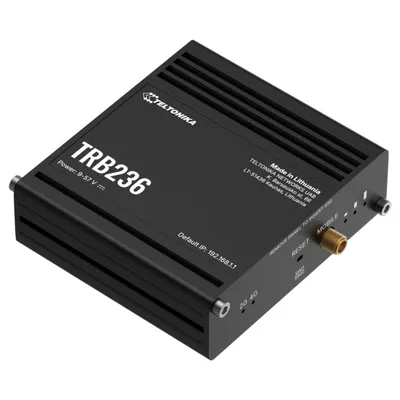
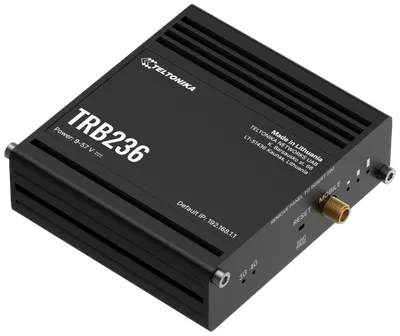
- TRB236 - Industrial IoT LTE 450 IoT Gateway, LTE CAT.1 / 2G, Dual-SIM TRB236 - I€186.34excl. VAT
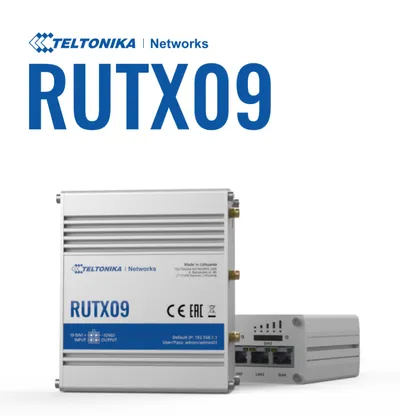
- TELTONIKA NETWORKS RUTX09 4G/LTE Router€254.59excl. VAT

- TELTONIKA NETWORKS RUT951 Dual SIM 4G/LTE/3G/2G Global WiFi Router€232.15excl. VAT

- Teltonika · Router · RUTX09 · Industrial LTE Modem Router Cat6 "ONLY LAN" 300Mbps Down/42Mbps UP€297.66excl. VATRRP €303.60−2%